Building an enterprise tool for retail data
Circana
An enterprise app that lets Circana's own product experts categorize the retail data behind its Fortune 500 analytics, and trains the model that does the rest.
Overview
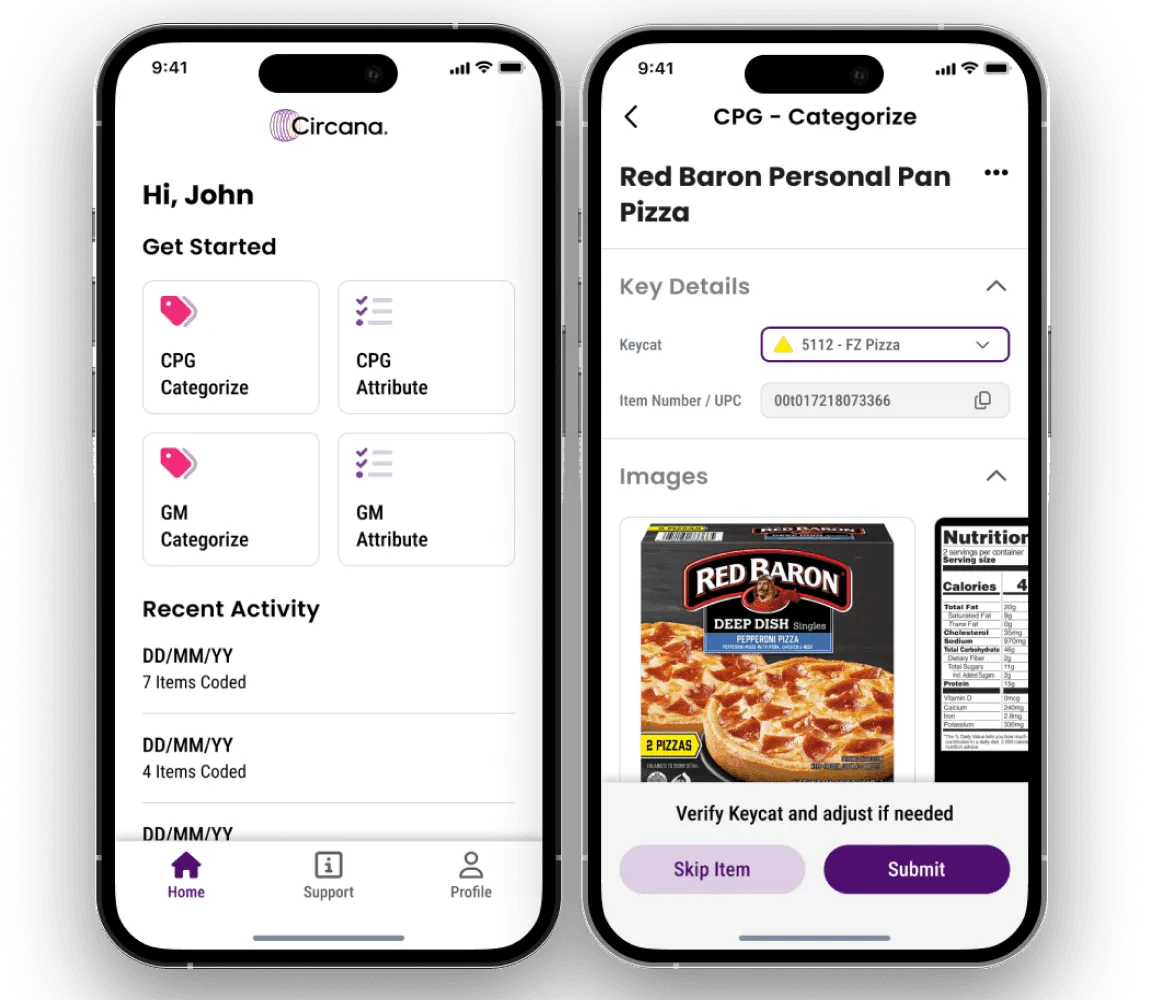
Magellan is an internal enterprise app at Circana, the market research company that tracks millions of products for Fortune 500 consumer goods, retail and healthcare companies. It lets Circana’s own product experts categorize those products from their phones, and every answer goes back into the model that categorizes the rest.
I led the design from the first wireframes in June 2024 to a beta with internal teams in January 2025, and then to 300 coders. From the start, I also guided the product, from the initial vision to the roadmap.
The problem. The ask was to bring Circana’s item categorization to mobile. In interviews, I found the cost wasn’t the screen. Categorization ran through expensive manual coding teams, while the client service experts who knew these products best had no way to contribute. So the question became how to turn expertise Circana already paid for into data its model could trust.
The outcome. Task completion rose 25% after the game layer and quality controls shipped together. Expert answers now join the coding team’s responses in Circana’s machine learning.

The Challenge
The brief I started from was a mobile version of the categorization work.
The interviews pointed somewhere else. Manual coding was costly, and when it backed up, product launches waited.
Meanwhile, Circana’s client service teams knew these products better than anyone, and nothing let them put that knowledge to use. So the app had to do more than move coding onto a phone. It had to let those experts teach the model.
The Research
I interviewed the client service and operations coding teams, and walked through the manual coding workflow with them. I turned what I heard into workflow maps and checked those maps with the teams.
Early wireframe prototypes tested the first flows. Then I set feature priorities with project leadership.
The Discovery
The research came back with a short brief.
- Business impact
- Off-shore coding teams were expensive, and the product expertise Circana already employed went unused.
- User needs
- Client service experts wanted to contribute. They needed it on their phones, in a way that fit the work they already did, and they wanted the app to recognize what they knew.
- Technical needs
- The app had to plug into the existing coding workflow and Circana's machine learning systems, and validate every answer before it reached them.
The Ideation
How might we build a mobile tool that captures internal product expertise while reducing reliance on manual coding?
I set the requirements with the product owner, project lead and engineering lead. Two of them pulled against each other. Answers had to be accurate enough to train the model, and experts had to keep coming back to a task that wasn’t their main job.
The Design
The design went through four phases across 2024 and into 2025.
- Foundation
- June 2024. Wireframes for a mobile-first app, a design system aligned to the Circana brand, and requirements checked with stakeholders.
- Iteration
- July to August 2024. High-fidelity designs and interactive prototypes, regular reviews with the VP of Design, and quality-control workflows refined with product and engineering.
- Evolution
- September to October 2024. The game layer and achievements, a React Native front end, and a back end wired into the product databases and ML systems.
- Beta and QA
- December 2024 to January 2025. Beta testing with internal teams, test cases covering both design and function, and fixes from their feedback.
Reward good answers, not more answers
Points for volume would have brought experts back and trained the model on rushed answers. I designed the game layer and the quality controls together, so contributing well was also the part that felt good.
Task completion rose 25% after the two shipped together.
The Solution
Onboarding gets a first-time expert to a first task quickly. From the home screen, a coder moves into a categorization task in a couple of taps: pick up an item from the queue, confirm or adjust its category, add attributes, and submit. Each screen asks for one decision.
Where This Goes Next
The direction I pushed for is steadily less manual coding. As more experts contribute, the model should take more of the routine items, and the coding teams should only see what it can’t place.
The number that would show it working is the share of items the model places without a coder. Before Magellan, hired coding teams placed every one by hand.